

Preparing for exams can often feel overwhelming, especially when faced with large volumes of material to memorize and understand. Fortunately, flashcards have stood the test of time as one of the most effective study aids, combining simplicity with powerful cognitive science principles like active recall and spaced repetition.
In 2025, advancements in AI technology have revolutionized how flashcards are created and used, making it easier than ever to generate personalized, efficient study tools. To help you find the best option, we tested over 50 online flashcard services and carefully selected the top 4 based on usability, features, and learning effectiveness. Whether you’re a student, educator, or professional looking to boost your learning, using the best flashcard maker tools can save you time and help you study smarter, not harder.
The Science Behind Memorizing with Flashcards
The use of flashcards as a study aid has endured for decades because of its grounding in well-established cognitive science. At the heart of what makes a flashcards maker effective are two key principles: active recall and spaced repetition.
A recent study looked at how spaced repetition helps doctors learn and remember better. The study found that doctors who used spaced repetition remembered information longer and could use it better in real situations. As the researchers said, “spaced repetition improves knowledge retention and transfer” (Academic Medicine, 2023). This shows how powerful flashcards and similar methods can be for learning.
How Flashcards affect your brain
Flashcards don’t just help you memorize facts; they actively engage your brain’s learning and memory systems in powerful ways. When you use flashcards, your brain undergoes specific processes that enhance retention and recall.
First, flashcards stimulate active retrieval, which involves recalling information from memory without prompts. This retrieval practice strengthens the neural pathways associated with that knowledge, making it easier to access later.
Second, flashcards promote spaced repetition, a timing strategy that revisits information at increasing intervals. This pattern exploits how your brain consolidates memories during rest, particularly during sleep, reinforcing learning and preventing forgetting.
Third, the repetitive exposure to key concepts via flashcards engages the hippocampus, a critical brain region for forming and retrieving long-term memories. This repeated activation helps transfer information from short-term to long-term storage.
Active recall: The mental workout
Active recall is the process of retrieving information from memory without the aid of prompts. Unlike passively reading or highlighting, this method forces the brain to engage deeply with the material.
When using flashcards, each question demands this mental workout, strengthening neural connections that improve long-term retention
This is why flashcards have become a cornerstone technique for students preparing for exams or professionals learning new material.
Numerous studies support the power of active recall in boosting learning efficiency. For example, Karpicke and Blunt (2011) demonstrated that practicing retrieval through testing enhances retention better than repeated study sessions. Similarly, Roediger and Butler (2011) reviewed decades of research showing that active recall promotes stronger and longer-lasting memory traces compared to passive review methods.
Spaced repetition: Timing is everything
Another critical component in effective memorization is spaced repetition. This strategy involves reviewing flashcards at carefully spaced intervals, just before the information is likely to be forgotten. Studies have shown that spaced repetition dramatically slows down the natural “forgetting curve,” allowing learners to retain knowledge more effectively over time. Many modern flashcards AI tools are built around this principle, automatically adjusting review schedules based on individual performance.
Top AI Flashcard Generators in 2025: Comparison
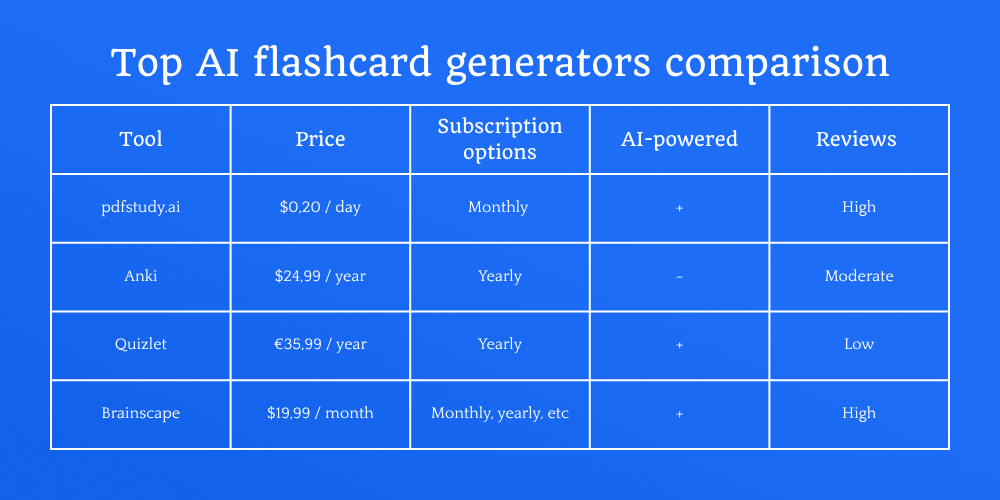
In 2025, the landscape of flashcard makers has been transformed by AI technology, making it faster and easier than ever to create effective study tools. As dedicated users of flashcard platforms, we tested over 50 online services and selected the top four — most of which now feature integrated AI to streamline the learning process.
pdfstudy.ai: Newest and fastest AI Flashcard Maker with smart document parsing
pdfstudy.ai stands out in 2025 as one of the most efficient and intelligent AI flashcard makers available. Designed for speed, accuracy, and simplicity, it allows users to instantly generate flashcards from PDFs, notes, and other learning materials — making it ideal for students, educators, and professionals who want to save time and focus on what matters most: learning.
Its core strength lies in its powerful document-parsing engine. Users simply upload a file or paste content, and the AI intelligently extracts key concepts, questions, and terms to generate flashcards. The platform supports large documents, technical subjects, and even lecture slides, producing relevant and well-formatted cards in seconds.
The interface is clean and distraction-free, with no ads or unnecessary features. Unlike some platforms that require significant manual editing, pdfstudy.ai minimizes effort by delivering ready-to-use cards that need little to no tweaking. Users can also edit cards if needed, organize them into decks, and study using a spaced repetition system optimized for long-term retention.
While pdfstudy.ai is focused on simplicity, it may not offer some of the social sharing features or gamified modes seen in tools like Quizlet — though for most serious learners, this isn’t a drawback. Additionally, its design favors a minimalist approach, which may feel basic to users looking for heavy visual customization. However, this choice supports speed, clarity, and function over fluff.
Strengths of pdfstudy.ai:
- Fast and accurate AI flashcard generation from PDFs and notes
- Ideal for students, exam prep, and professionals
- Clean, intuitive interface with no distractions
- Supports large files and technical content
- Built-in spaced repetition for efficient learning
- Little to no manual editing required
Minor limitations:
- Lacks gamified study modes (intentionally streamlined)
- Focuses on productivity over community-sharing features
Anki: The classic flashcard maker
Anki is a long-standing flashcard maker known for its effectiveness in spaced repetition learning. It’s widely used by medical students, language learners, and professionals preparing for rigorous exams. One of Anki’s greatest strengths is its flexibility — users can customize decks extensively, add images, audio, and even create advanced card types using LaTeX or HTML.
However, this power comes with a steep learning curve. Flashcards must be created manually, and even basic setup can be confusing for beginners. There is no built-in AI to generate cards from existing study materials, meaning users must spend time inputting content and formatting it themselves. Anki also lacks modern UI design and cloud-based automation features found in more recent tools. While plugins can extend functionality, they often require technical knowledge to install and use properly.
Strengths of Anki:
- Highly customizable with support for multimedia
- Uses a proven spaced repetition algorithm
- Large library of shared community decks
Limitations:
- Manual flashcard creation only
- Complex interface not suited to casual users
- Limited collaboration and syncing across platforms
- No AI-powered automation or document parsing
Quizlet: Flashcard maker with AI enhancements
Quizlet is a well-known flashcard maker that gained popularity among students for its simplicity and attractive design. It allows users to create flashcards, study with interactive modes like “Match” or “Learn,” and explore a vast library of user-generated sets across subjects from languages to history.
One of Quizlet’s main strengths is its accessibility — the interface is clean and easy to use, making it a go-to for younger students and casual learners. However, its recent shift toward monetization has reduced its appeal. Many core features, such as advanced study modes, smart grading, and offline access, are now locked behind a paid subscription. In addition, while Quizlet offers some automation, it’s limited — there is no advanced AI for document parsing or auto-generating cards from PDFs or external sources.
Quizlet is ideal for quick studying and visual learners but may not be the best choice for those seeking deeper customization, automated input, or more rigorous learning strategies.
Strengths of Quizlet:
- Very user-friendly interface
- Broad selection of community-made decks
- Fun and interactive study modes
Limitations:
- Increasingly paywalled features
- No true AI flashcard generation
- Limited support for large or complex content
- Basic customization compared to advanced tools
Brainscape: Clean design, but limited flexibility
Brainscape is a digital flashcard platform designed around confidence-based repetition. It asks learners to rate how well they know each card, then uses an algorithm to optimize review timing. This method can be effective for reinforcing knowledge, especially in subjects like test prep, languages, and business training.
The interface is clean and professional, and Brainscape offers collaborative features for educators and teams. However, customization is fairly limited. Users can’t easily format cards beyond simple text, and there’s no support for multimedia like images or audio in the free version. More importantly, Brainscape lacks AI-powered generation — users must manually input content, which makes the process slower and less efficient for large volumes of material.
Additionally, while Brainscape promotes a structured, no-frills approach to studying, this simplicity comes at the cost of flexibility. For advanced learners who want dynamic flashcard creation, personalized formatting, or automated extraction from documents, Brainscape may feel restrictive.
Strengths of Brainscape:
- Confidence-based repetition system
- Simple and clean user interface
- Designed for both individuals and teams
Limitations:
- Manual flashcard creation only
- No AI generation or document integration
- Limited media support in free version
- Fewer customization options compared to other platforms
We believe pdfstudy.ai is the most affordable and user-friendly flashcard maker available in 2025. pdfstudy.ai offers a clear and transparent subscription model, the opportunity to try the tool for free, and no ads or distracting extra features that can interfere with focused learning.
pdfstudy.ai is built on AI algorithms and inspired by the best practices of top flashcard tools ever created. Its design prioritizes speed and simplicity, making it an ideal solution for students, professionals, and lifelong learners alike.
What Is The Best Online Flashcard Maker
Finding the best online flashcard maker means looking for specific features that make studying efficient, easy, and effective. Here are the key criteria to consider.
Key criteria for a flashcard maker
- Ease of use. The ideal tool should be intuitive and straightforward, letting users create flashcards with minimal effort. pdfstudy.ai excels here with a clean, user-friendly interface that lets you generate flashcards in just a few clicks — no steep learning curve, no confusing menus.
- AI-Powered generation. Automatically generating flashcards from your study material saves valuable time. pdfstudy.ai uses advanced AI to analyze PDFs, images, and text, extracting essential information and creating high-quality flashcards instantly, far faster than manual methods.
- Versatile input formats. A good flashcard maker accepts multiple file types so you can upload notes in the format you already have. pdfstudy.ai supports PDFs, PNG, and JPEG files up to 50 MB, making it incredibly flexible for all kinds of study resources.
- Spaced repetition & Learning optimization. Effective flashcard tools integrate spaced repetition to help learners retain information longer. pdfstudy.ai incorporates proven spaced repetition algorithms, ensuring flashcards reappear at the best intervals to maximize memory retention.
- Minimal distractions. Studying demands focus — ads or irrelevant features only get in the way. pdfstudy.ai provides an ad-free, distraction-free environment that keeps your attention on learning, with no clutter or unnecessary extras.
- Affordable & Transparent Pricing. Knowing exactly what you pay for matters. pdfstudy.ai offers a clear subscription model with no hidden fees and includes a free trial, so users can test the platform risk-free before committing.
- Customizability & Editing. While AI does most of the work, you still need to tweak cards to suit your needs.
When it comes to choosing the best flashcard maker in 2025, it’s clear that the most effective tools share a few key qualities: fast AI-powered generation, support for various content types like PDFs and notes, a clean and distraction-free interface, built-in spaced repetition, and minimal manual work. Flashcard makers that meet these standards offer a major advantage for students, professionals, and lifelong learners who want to retain information efficiently and study with confidence.
How to Make Flashcards: pdfstudy.ai Easy Way
Creating flashcards online has never been easier. Follow these quick 3 steps to generate a full flashcard set in seconds:
1. Go to https://pdfstudy.ai/.
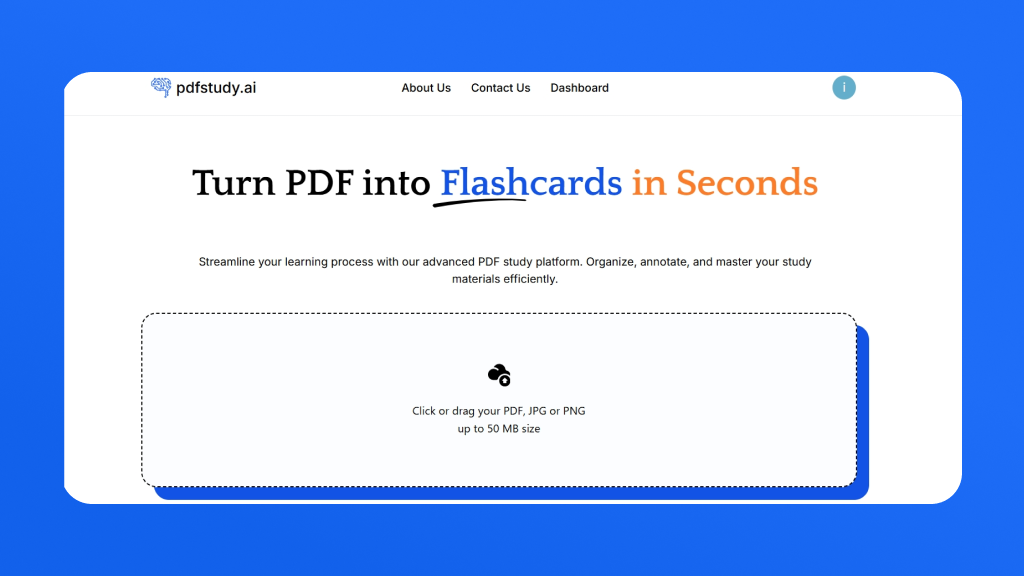
2. Upload your file: Add or drag and drop your document (PDF, PNG, JPEG – up to 50 MB).
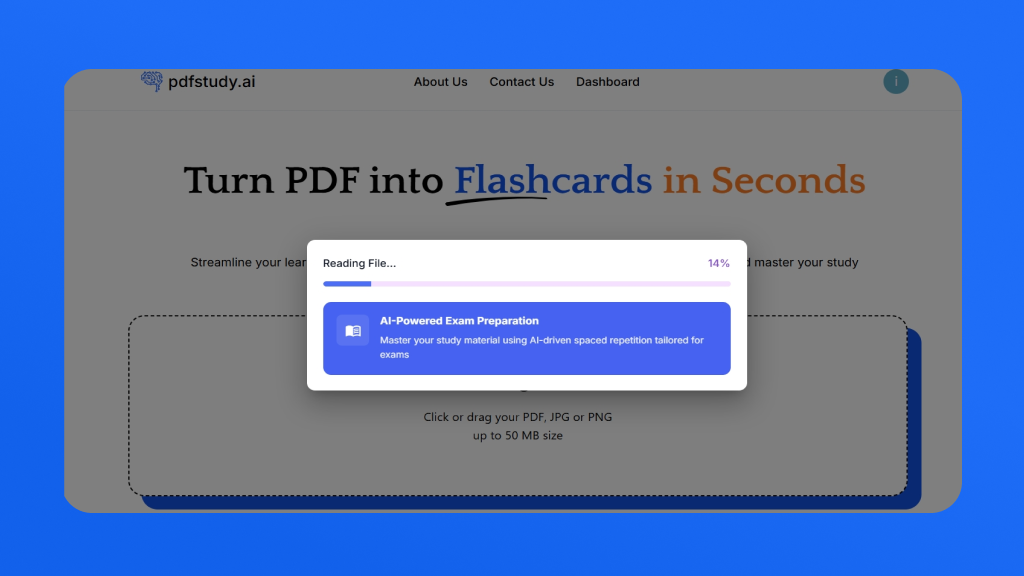
3. Generate your flashcards: Instantly receive a complete set of AI-generated flashcards. Start studying!
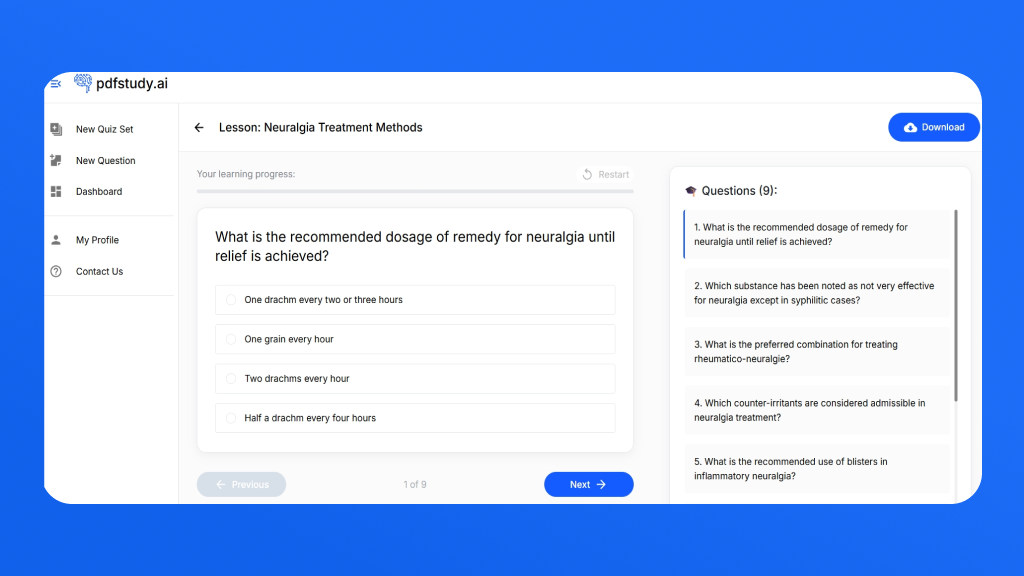
It’s that fast — no manual typing, no wasted time.
How to use flashcards
- Open your flashcard deck. After generating or uploading your cards, select a deck to begin your study session.
- Read the question and choose an answer. Focus on recalling the answer from memory before checking your notes.
- Check the answer. Click on the answer to reveal it and compare it with what you remembered.
- Repeat later on if needed. Study a little each day: pdfstudy.ai automatically adjusts the review frequency to boost long-term retention and will remind you the information that you need to repeat.
Using flashcards isn’t just simple — it’s scientifically proven to boost memory. Techniques like active recall (pulling information from memory) and spaced repetition (reviewing just before forgetting) are two of the most effective learning strategies.
With consistent daily practice and assessment with the help of tools like pdfstudy.ai, flashcards help transfer knowledge into long-term memory. Whether you’re studying for exams or learning new skills, flashcards turn passive reading into active, brain-strengthening learning.
FAQ: Flashcards & Online Study Tools
How often should I review my flashcards?
To get the best results, review your flashcards daily using spaced repetition. This means revisiting cards at increasing intervals (e.g., 1 day, 3 days, 7 days) — just before you’re likely to forget the information.
What kind of content works best for flashcards?
Flashcards are most effective for definitions, formulas, key terms, concepts, and questions. They work especially well for subjects like medicine, languages, law, and science — anything that requires active recall.
Is it better to create my own cards or use auto-generated ones?
Both have benefits. Auto-generated cards save time and help you start quickly. Editing or adding your own improves learning by actively engaging with the material.
Do flashcards really improve long-term memory?
Absolutely. Studies have shown that active recall and spaced repetition significantly enhance long-term retention compared to passive study methods like rereading or highlighting.